

The short answer to how to pick the right golf ball for your swing speed: match your driver speed to a compression range, then adjust for how you deliver the club. Under 85 mph, look at low compression golf balls for slow swing speed, usually in the 30 to 70 range. Between 85 and 100 mph, mid compression around 70 to 90 works best. Above 100 mph, firmer balls near 90 and up tend to hold up.
Why Swing Speed Is the Starting Point for the Right Golf Ball
A golf ball is a spring. At impact it squashes against the face, stores energy, then pushes back as it leaves. How much it squashes depends on how hard it is hit and how soft the core is.
Compression ratings describe that softness. Modern balls generally run from around 30 at the very soft end to over 100 at the very firm end, and manufacturers design each core to match the force a certain swing speed applies. Engineering research on ball impact treats the ball as a multi-layer material system whose core and cover behave in a non-linear way under load (research on golf ball impact mechanics).
Get the match wrong in either direction and you lose something. Too firm for your speed and the ball never fully compresses, so you give up ball speed and feel. Too soft for your speed and the ball over-compresses, spins up and can balloon into the wind.
Find Your Swing Speed Range
Everything that follows keys off one number: your driver clubhead speed. If you have never measured it, a launch monitor at a local shop or a cheap radar unit will give you a figure in five minutes. There is also a rough method using carry distance, covered in the FAQ below.
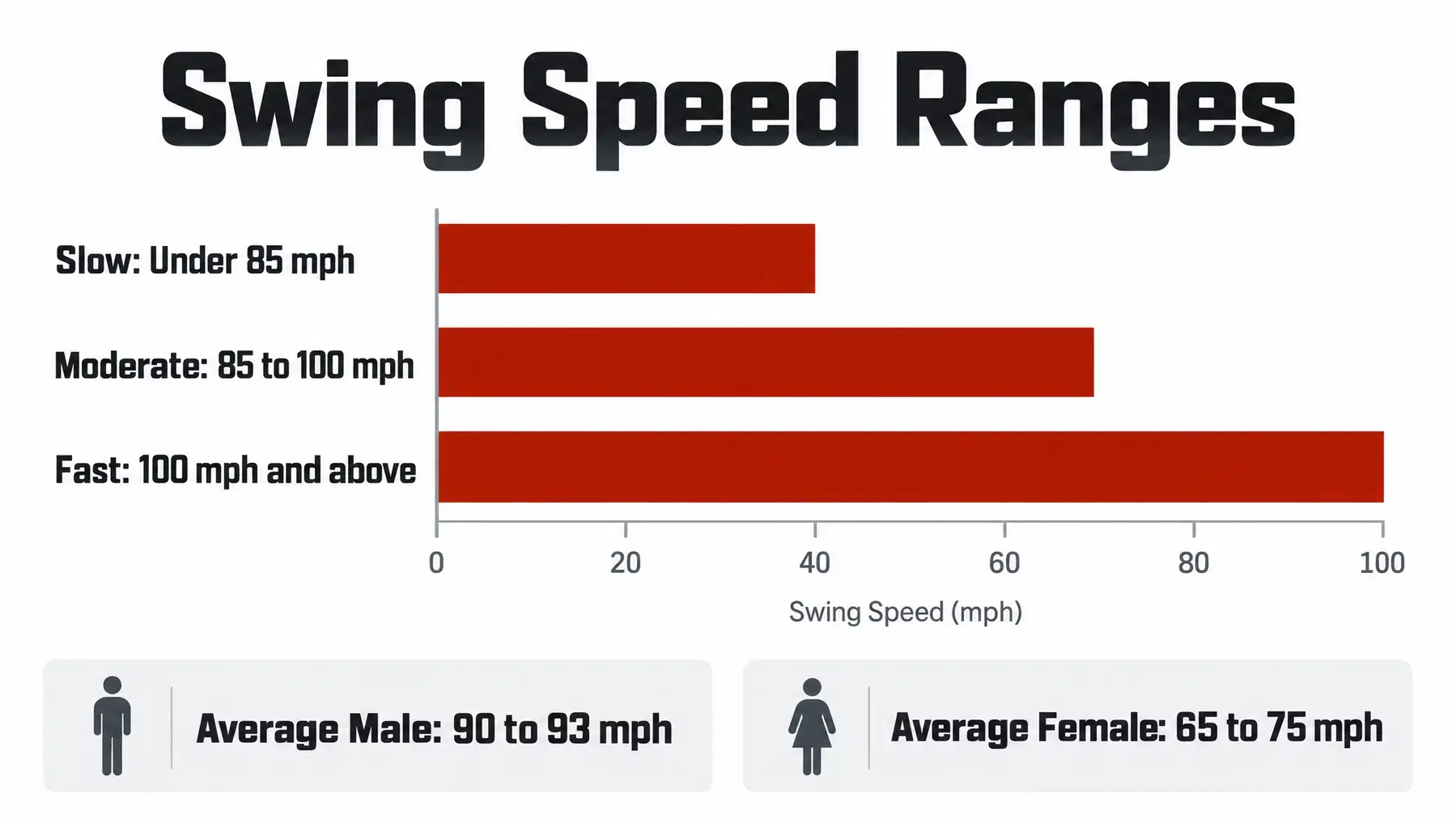
- Slow: under 85 mph. Common for many seniors, most women golfers and newer players. Carry distance with a driver typically sits under about 200 yards.
- Moderate: 85 to 100 mph. The biggest group of club golfers. Average amateur male driver speed falls roughly in the 90 to 93 mph band, so most men land here.
- Fast: 100 mph and above. Low handicappers, long hitters and competitive players. Average female amateur speed sits well below this, closer to 65 to 75 mph.
How to Pick the Right Golf Ball for Your Swing Speed by Compression
Here is the direct mapping. Treat it as a golf ball compression chart you can use at the shop shelf, then read the next section before you commit to a dozen.
| Driver swing speed | Target compression | Typical construction | What you gain |
|---|---|---|---|
| Under 85 mph | Roughly 30 to 70 | 2-piece, ionomer or soft cover | Full compression, higher launch, softer feel |
| 85 to 100 mph | Roughly 70 to 90 | 2-piece distance or 3-piece | Balanced distance and control |
| 100 mph and up | Roughly 90 and above | 3-piece or 4-piece urethane | Spin control, stable flight, firmer feedback |
Under 85 mph. Prioritise a soft core and low spin off the tee. A 2-piece ball in the 60s is the safe default, and a golf ball for seniors slow swing speed buyers should rarely climb past 70 compression. Zero Friction's Stryker Distance ball is built for exactly this job, and the matte finish Spectra balls bundled in the Men's SuperTubes use a 2-piece, 80 compression build that suits the upper end of this bracket and the start of the next.
85 to 100 mph. You have enough speed to compress a mid-range core fully, so the question becomes how much greenside spin you want. A firm 2-piece distance ball gives you roll-out. A 3-piece ball gives you a softer landing. The Victory Tour 3-piece urethane ball sits here for players who want distance without giving up feel into greens.
100 mph and up. Soft balls start spinning too much and drifting. Go to a firmer multi-layer urethane model and accept the firmer feel as the price of a stable ball flight. Players at this speed who want maximum short-game bite often look at a dedicated spin model such as the Tour Spin golf balls.
Why Swing Speed Alone Doesn't Tell the Whole Story
This is the part most guides skip. Two golfers can both swing at 95 mph and still need different balls, because speed only tells you how fast the club is moving, not how it arrives.
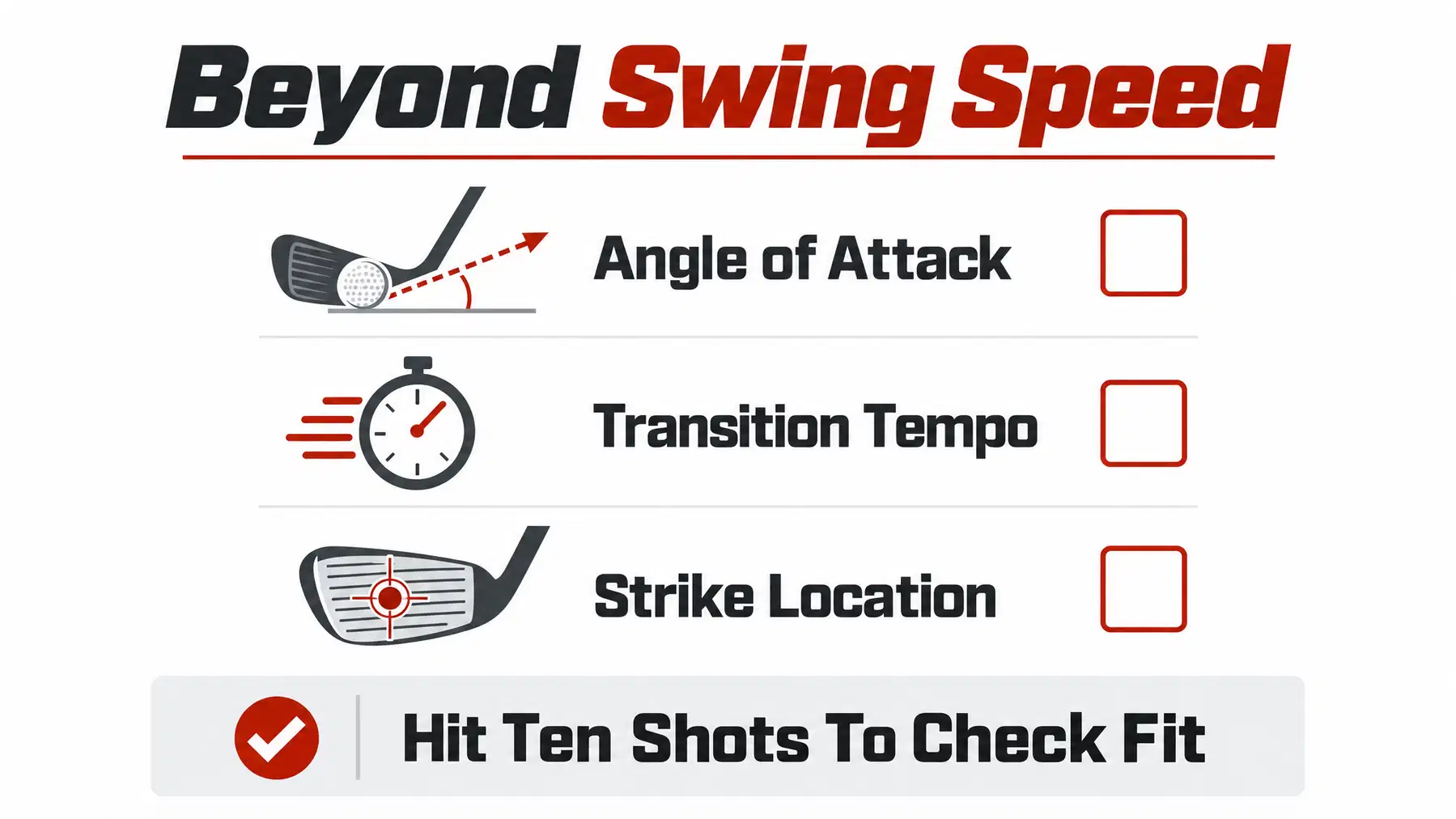
- Angle of attack. Hitting up launches high with low spin; hitting down adds spin. A steep 95 mph player can balloon a soft ball that a shallow 95 mph player flights perfectly.
- Transition tempo. A sharp, aggressive move from the top loads the ball harder than a smooth one at the same measured speed, so quick transitions usually prefer one tier firmer.
- Strike location. Off-centre hits lose speed, so if you only find the middle occasionally, the softer end of your bracket is more forgiving.
Here is the simple sanity check. Hit ten shots with the ball your speed bracket recommends. If the flight balloons, stalls in the wind or feels mushy at impact, move one tier firmer. If shots feel dead, come out low and lack carry, move one tier softer.
Match Spin and Layers to Your Game, Not Just Your Speed
Layer count is the second lever, and it governs the relationship between golf ball spin and swing speed more than compression does. A 2-piece ball has a large core and a durable cover. A 3-piece ball adds a mantle layer between them, which lets the cover spin independently on short shots while the core still handles the driver.
| Construction | Driver spin | Greenside spin | Best suited to |
|---|---|---|---|
| 2-piece | Lower | Lower | Slow to moderate speeds, straighter flight, value per dozen |
| 3-piece | Moderate | Higher | Moderate to fast speeds, players who attack pins |
| 4-piece and up | Lowest off driver | Highest | Fast speeds and consistent strikes |
The 2-piece vs 3-piece golf ball decision is not purely a speed question. A 78 mph player who hits a lot of greens still benefits from a soft 3-piece urethane ball, even though a 2-piece model would roll out further off the tee.
Test and Confirm Your Ball on the Course
Charts narrow the field. The course decides. Pick two or three candidate models from your bracket and run this before you buy a case.
- Hit three to five of each model on full driver swings from the same tee box, watching how the ball behaves in the last third of its flight.
- Repeat with a mid iron. Look for a flight you can control into a headwind.
- Chip and pitch five shots with each from the same lie, noting first bounce and how quickly each ball settles.
- Keep the ball that gave you the most predictable result, not the longest single shot.
To test cheaply, buy sleeves of three rather than dozens, or split a dozen with a playing partner. Multi-ball sampler packs such as the ball and tee Supersleeve are another low-cost way to get a few models into play before committing.
Quick Reference: Swing Speed to Golf Ball Fit
| Speed bracket | Compression | Construction | Example use case |
|---|---|---|---|
| Under 85 mph | 30 to 70 | 2-piece soft, or soft 3-piece if you want spin | Senior or new golfer chasing carry distance |
| 85 to 95 mph | 70 to 85 | 2-piece distance or 3-piece | Average male club golfer wanting balance |
| 95 to 100 mph | 80 to 90 | 3-piece urethane | Single-figure player who attacks pins |
| 100 mph and up | 90 plus | 3-piece or 4-piece urethane | Long hitter needing spin and flight control |
Find your row, buy two sleeves from it, and run the on-course test. Then adjust one tier if the flight or feel tells you to. That is the whole process, and it costs less than one bad dozen.
Frequently asked questions
What happens if I use a high-compression ball with a slow swing speed?
You will not generate enough force to fully compress the core, so the ball leaves the face slower, usually with a shorter carry and a hard, dead feel at impact.
How do I calculate my golf swing speed without a launch monitor?
Divide your average carry distance with a driver by roughly 2.3 to get a rough mph figure, so a 200-yard carry suggests about 87 mph.
Does a softer golf ball go further for slow swing speeds?
Often yes, because a slower swing can fully compress a soft core and transfer energy efficiently. The gain is usually modest, a few yards rather than a transformation.
Is there a specific golf ball for seniors with slower swing speeds?
There is no senior-only category, but the same fitting logic applies: look for compression under about 70 and a 2-piece or soft 3-piece build.
Should I choose my golf ball based on driver speed or 7-iron speed?
Start with driver speed, since it sets the upper limit on compression. Use 7-iron speed as a cross-check, and if the two disagree, trust the softer recommendation.
Do professional golfers always use high-compression balls?
Most do, because their speed and strike quality let them compress firm cores fully and benefit from the spin control. Their choices are not a reliable guide for a 90 mph amateur.
What is the difference between a 2-piece and a 3-piece golf ball for swing speed?
A 2-piece ball keeps spin low, suiting slower to moderate speeds looking for distance. A 3-piece ball adds a mantle layer so the cover spins more on wedges while the core still handles the driver.
Can a high swing speed player use a low-compression ball?
Yes, but expect extra spin and a higher flight that becomes unstable in wind. Test it on a windy day before you commit.
Leave a comment