

Why Properly Fitted Gloves Matter More Than Most Golfers Think
The importance of properly fitted gloves comes down to one simple idea: fit, not material alone, decides whether a glove helps your golf swing or quietly works against it. A premium leather glove in the wrong size will still slide, bunch and steal feel from the handle.
Hand-protection research outside golf makes the mechanism clear. Even thin gloves reduce dexterity and sensitivity, which often makes people grip an object more tightly than they would bare-handed, and reduce how long a grip can be held [S4]. On a golf course, that translates to tension, fatigue over 18 holes and inconsistent contact.
The Importance of Properly Fitted Gloves for Grip and Control
A loose glove behaves like a second layer of skin that is not attached to you. Spare material across the palm lets the glove rotate a few millimetres on the grip during the downswing. That micro-slippage is small, but it arrives at the exact moment the clubface is squaring up, and it shows up as a face that is a degree or two open or shut.
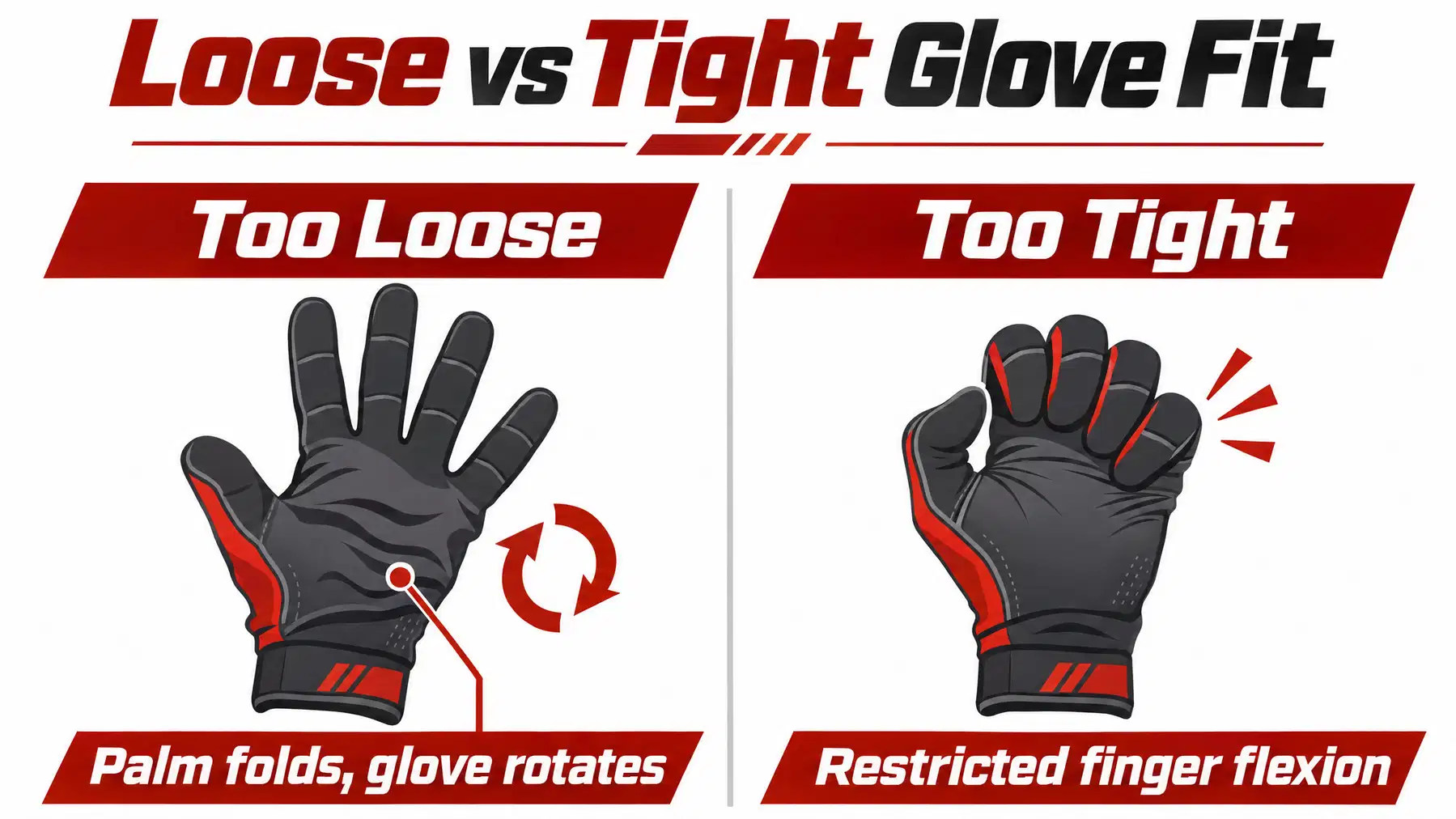
A glove that is too tight causes the opposite problem. It restricts the finger flexion you need to hinge and release the club naturally, so your hands fight the glove instead of the club. Grip strength measurements show that gloves reduce grip force compared with a bare hand, and stiffer designs reduce it most [S1].
Reduced touch is part of it too. Lab testing of gloved hands has found that donning gloves decreases tactile sensitivity [S3], making consistent grip pressure harder to repeat.
Key takeaway: A correctly fitted golf glove should feel like skin under tension. No folds in the palm, no pinching at the fingertips, no gap at the wrist.
How Glove Fit Affects Your Golf Swing, Not Just Your Hand
Golf asks something unusual of a glove. Grip pressure has to stay stable from address all the way to follow-through, and elite players are notably more consistent swing to swing in how that pressure changes [S6]. A glove that shifts mid-swing forces you to re-grip unconsciously, and re-gripping is one of the fastest ways to lose a clubface.
Traditional small, medium, large and XL charts assume every hand of a given length has the same width, finger length and palm depth. They do not. Compression-fit designs solve this differently: the material stretches to the shape of your hand rather than asking your hand to match a size band. The Zero Friction Performance Golf Glove uses that universal compression-fit approach, with a hybrid synthetic leather and breathable construction.
Signs Your Golf Glove Doesn't Fit Right
Run this checklist next time you pull a glove on at the first tee.
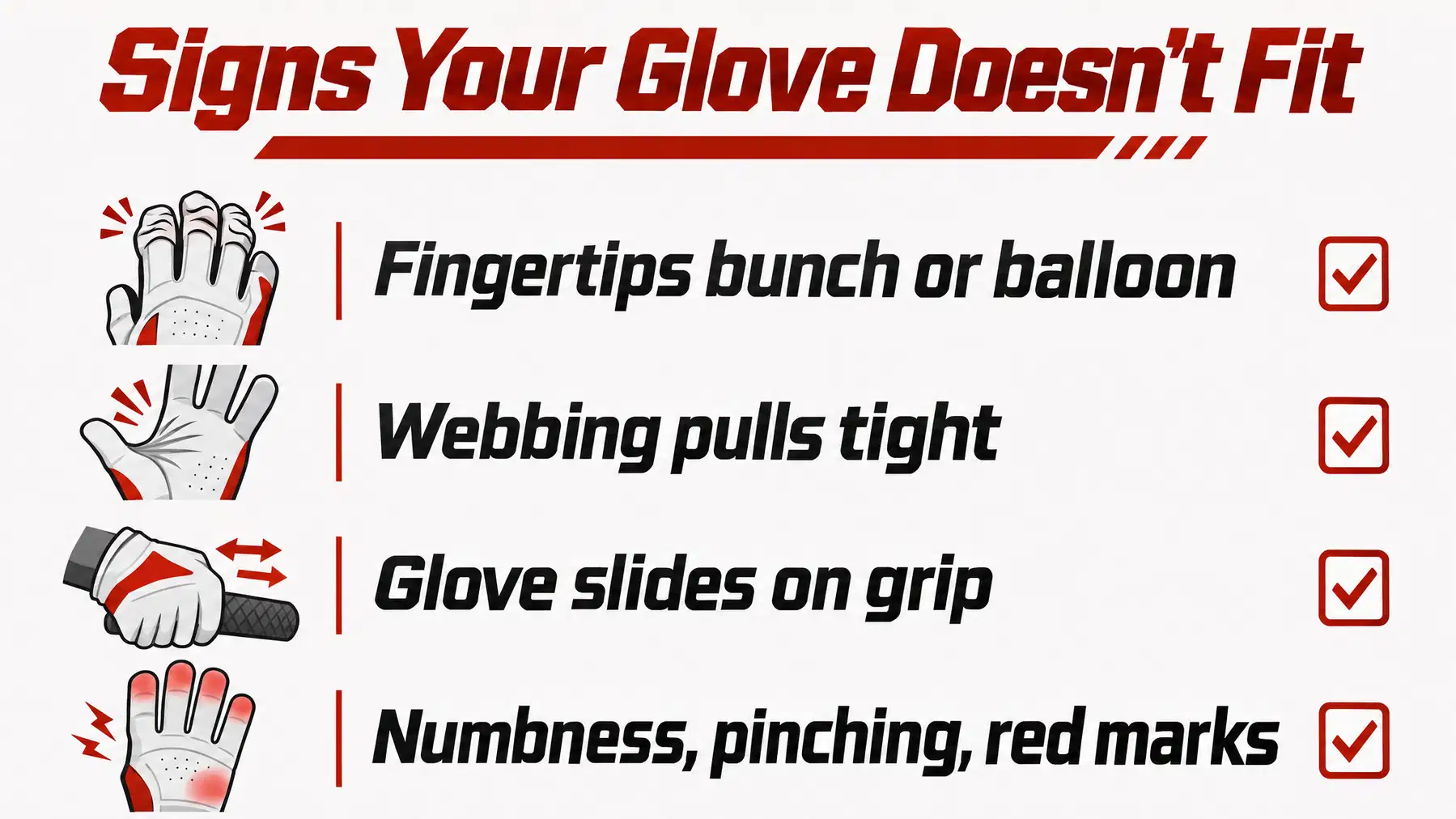
- Fingertips bunch or balloon. Empty material at the tips means the glove is too long.
- The webbing pulls. Tightness between thumb and forefinger means the glove is too small across the palm.
- The glove slides on the grip, or you re-grip between shots. Loose palm material lets it rotate during the swing.
- Numbness, pinching or red marks. A sign of a glove that is too tight, not one that needs breaking in.
Why a Universal Fit glove works
- Stretches to your hand, not a size chart. The Zero Friction Performance Golf Glove uses a universal compression-fit material that stretches to the shape of your individual hand instead of forcing your hand into a rigid small, medium or large band.
- Molds to your grip over time. The fabric flexes with every finger and knuckle, so the glove settles into the contours of your hand and holds that shape, closer to a second skin than a standard glove.
- One glove, a personal fit. Because the material does the adjusting, a single universal size comfortably covers a wide range of hand shapes, so you spend less time chasing the right size and more time on consistent grip pressure.
- Snug without pinching. A true compression fit stays close across the palm to prevent slippage, while still leaving the fingers free to flex and release the club naturally.
| Fit issue | What you feel | Effect on the swing |
|---|---|---|
| Too loose | Folds in the palm, glove twists | Micro-slippage, clubface inconsistency |
| Too tight | Pinching, numbness, pulled webbing | Restricted release, extra grip tension |
| Correct | Second-skin snugness, no folds | Stable grip pressure, better feedback |
Frequently asked questions
How should a golf glove fit?
A golf glove should fit like a second skin, snug across the palm with no loose folds and minimal empty space at the fingertips. It should feel firm in a fist without pinching, with the wrist closure lying flat.
What are the risks of wearing gloves that are too tight?
A glove that is too tight restricts finger flexion and can cause pinching, numbness and pressure marks, adding grip tension that tires your hands over a round.
Can a loose golf glove cause mishits?
Yes. A loose glove can rotate slightly on the handle during the downswing just as the clubface is squaring up, causing inconsistent face control.
Why is dexterity important when choosing a golf glove?
Dexterity is how freely your fingers move and how much detail you feel through the handle. Even thin gloves reduce dexterity and sensitivity, so the best-fitting glove that still does its job is usually right.
How does glove fit affect grip strength and hand fatigue?
Gloves reduce measured grip strength compared with a bare hand, and stiffer or poorly fitted gloves reduce it most, speeding up hand fatigue over a round.
Leave a comment